Tuesday, April 7, 2015

30 (D-32) Water: Lake Pontchartrain / Canals / Katrina / Stormy weather

New Orleans is WATER also.

Music first:  https://www.youtube.com/watch?v=qwLmqWnZU40  Ma Nouvelle Orléans

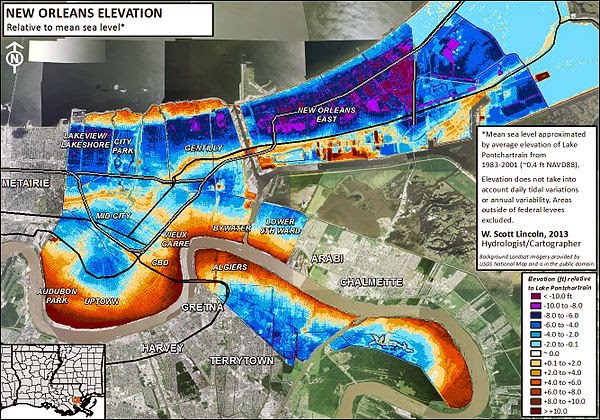
Elevation map of New Orleans.  Blue/purple indicates elevations below the average level of Lake Pontchartain (1983-2001) and orange/brown indicates elevations above.

1.  New Orleans is partly below sea level. Roughly half the city and surrounding metropolis is above sea level. 

2.  Lake Pontchartrain is named for Louis Phélypeaux, comte de Pontchartrain.  He was the French Minister of the Marine, Chancellor and Controller-General of Finances during the reign of France's "Sun-King", Louis XIV.  Lake Pontchartrain is not a true lake, but an estuary connected to the Gulf of Mexico.  It is one of the largest wetlands along the Gulf Coast of North America.

3.  The Lake Pontchartrain Causeway, is a causeway (a raised road or path that goes over wetlands or water) composed of two parallel bridges crossing Lake Pontchartrain.  The longer bridge is 38.35 km long (23.83 miles).  Since 1969, it was the longest bridge over water in the world.  In 2011 it became the longest bridge over water (continuous) and Jiaozhou Bay Bridge in China became the longest bridge over water (aggregate).

4.  The Mississippi River  (See Entre 6 (D-6) March 14th)

5.  New Orleans has more total mileage of canals, both above and below ground, than Venice in Italy.  Canal Street, a famous street in New Orleans, was originally intended to be a canal but it was never built.

6.  Hurricane Katrina hit New Orleans on August 29, 2005.  Nearly every levee in metro New Orleans was breached as Katrina passed just east of the city limits and there was flooding in many places (80% of the city).  The final death toll was 1,836, primarily from Louisiana (1,577) and Mississippi (238).  More than half of these victims were senior citizens.  705 people are reported as still missing as a result of Hurricane Katrina.  The hurricane affected over 15 million people in different ways:  some people having to evacuate their homes, rising gas prices, and the economy suffering.

Jane

It's a sad way to end today's entry, but here's a little more music...STORMY WEATHER.  Three selections for you:


https://www.youtube.com/watch?v=QCG3kJtQBKo  (Lena Horne)
https://www.youtube.com/watch?v=EIgVCU19pjg  (Billy Holiday)
https://www.youtube.com/watch?v=ezGHapF8-lY  (Ella Fitzgerald)

Monday, April 6, 2015

29 (D-33) More WWII --> German submarines

DID YOU KNOW THIS?
German submarine U-166 was sunk on July 30, 1942, in the Gulf of Mexico, 72 km (45 miles) from the Mississippi River Delta, off the coast of Houma, Louisiana, by the SS Robert E. Lee.  A torpedo from U-166 hit the SS Robert E. Lee, which took about 15 minutes to sink. One officer, nine crewmen, and fifteen passengers died as the vessel went down.  404 survived.

And history here is even more interesting.  I do hope you will continue to read.  I give you help with the vocabulary.

We need to go back to early 1942.  At that time, the United States had greatly increased their naval presence in the Atlantic and presented a challenge to German U-boats who previously had patrolled with little resistance.  Consequently, the U-boats were sent to less militarized areas to patrol and harass.  The Nazis turned their attention to the Gulf of Mexico.  Heavy traffic from New Orleans and the steady flow of oil from the region made the waters a prime target.  The Gulf Coast was unprepared to defend against Nazi submarine attacks.  The Nazis felt they could significantly undermine the American war effort if they could successfully disrupt the free flow of oil.

On July 30, 1942, PC-566 was escorting the Robert E. Lee, which contained survivors from a previous submarine attack, back to New Orleans.  After the Robert E. Lee was attacked, the captain of PC-566, Herbert G. Claudius, retaliated.  According to Claudius, he witnessed debris and oil float to the surface and saw no sign of the submarine.  Although uncertain, he thought he had sunk the German submarine.  However, the Navy felt his story was certainly untrue, especially since Claudius had not yet received anti-submarine training and sinking a German U-boat was a daunting task.  Claudius was removed from command.

The U-166 and the SS Robert E. Lee were discovered in May of 2001 during a pipeline survey. U-166 was the only submarine successfully sunk in the Gulf throughout the entire war. 

In December 2014, researchers had found sufficient proof to confirm that it was indeed Claudius who destroyed the German submarine.  The Navy posthumously awarded him the Legion of Merit, a prestigious military award for extraordinary achievements.

In total, German U-boats sank over 70 vessels in the region, many alongside Louisiana's coast.  The American people, for fear of panic, were not informed that the Germans were so close to their coastline.

Jane ...who apologizes (s'excuse) for this difficult text, but so interesting, n'est-ce pas?
__________________________________________
sink-sank-sunk = couler
off the coast = au large de la côte
crewmen = l'équipage
the vessel went down = the boat sunk
to harass = to trouble by repeated attacks
flow = circulation
prime target = une cible de choix, une cible principale
to undermine = to weaken gradually or by degrees
disrupt = perturber
steady = here means "continuous", "regular"
free flow = libre circulation
tug boats (remorqueur d'escorte, bâteaux pilote) escort big ships 
to escort back = les accompagner pour le voyage de retour
retaliate = riposter
untrue = not true
since = here "because"
a daunting task = une lourde tâche, une tâche monumentale
removed from his command =  être relevé de son commandement
a survey = a study
indeed = certes
posthumously  =  after his death


Sunday, April 5, 2015

28 (D-34) The National World War II Museum


We will be leaving for Louisiana on May 9th.  I intentionally waited until the 9th to allow the group to be in France on May 8th, a significant date.  It will be the 70th anniversary marking the end of the Second World War (also written World War II or WWII).  I am certain there will be many ceremonies in our towns and cities everywhere in France (and Europe).  Victory Day* is an official national holiday in France.  This year it will be a special national day of remembrance and gratitude for the freedom we cherish today.
http://www.timeanddate.com/holidays/france/wwii-victory-day

In New Orleans we will also take time to look back at World War II, but through American eyes.  On May 12th, we are going to visit The National WWII Museum.  What an opportunity to visit this museum in May of 2015!

The Museum opened on June 6, 2000, the 56th anniversary of   D-Day.  Some people may wonder why The National WWII Museum is in New Orleans, a city known for other tourism sites but which is not usually associated with 20th-century military history. The Museum opened as the D-Day Museum, focusing initially on the amphibious invasion of Normandy, then opening a second gallery exploring the amphibious invasions of the Pacific War. Because the Higgins Boatsvital to D-Day operations, were designed, built, and tested in New Orleans by Higgins Industries, the city was the natural home for such a project

Furthermore, New Orleans was the home of historian Stephen Ambrose, a longtime professor of history at the University of New Orleans.  He served as the historical consultant for the movie Saving Private Ryan, and he spearheaded the effort to build the Museum.  He also wrote the book which inspired the mini-series Band of Brothers (Frères d’Armes)

The Museum closed for three months after Hurricane Katrina ravaged New Orleans in 2005, re-opening on December 3 of that year. A museum banner promoted this re-opening by proclaiming "We Have Returned," a phrase made famous by General Douglas MacArthur regarding his eventual return to the Philippines in 1944.

This museum was designated by the U.S. Congress as "America's National World War II Museum" in 2003, and the Museum maintains an affiliation with the Smithsonian Institution in Washington D.C. The museum's objective is to emphasize the American experience in World War II.

The National WWII Museum's exhibits show us the war that changed the world, in a voice that is intimate and personal, right in the heart of New Orleans. Exhibits not only highlight the role of world leaders, but also the everyday men and women who found the strength and courage to accomplish the extraordinary.

Currently housed in three buildings, each arranged around central themes of the war, Museum exhibits offer visitors an opportunity to experience the war through the eyes of the men and women who lived it. 

Jane...who apologizes for making this so long today, but it is very interesting, n'est-ce pas?!
____________________________________
Victory in Europe Day, generally known as V-E Day, VE Day, or simply V Day.
to wonder =  se demander
to focus on something = se focaliser sur quelque chose
to design =  dessiner 
furthermore =  de plus, en outre
to spearhead =  être à l'origine de 
mini-series =  un téléfilm en plusieurs parties
banner =  une banderole
to promote =  promouvoir
regarding = à propos de
to emphasize = mettre l'accent sur le fait; souligner
exhibits = les expositions
right = here, exactement
housed =  here, "house" is a verb, abriter 

Higgins boats:
https://www.tumblr.com/search/landing%20craft%20vehicle%20personnel  
Saturday, April 4, 2015

27 (D-35) Mardi Gras -- Street Music

New Orleans is Mardi Gras...and a lot of music in the streets at that time.  I introduced my students to Louisiana Mardi Gras in fact on February 17, 2015 which was Mardi Gras this year.  You'll need to return to the Uiad blog to see this information again.
https://uiadleblog.wordpress.com/2015/02/18/mardi-gras-en-louisiane/

Bourbon Street and Canal Street in New Orleans, where a lot of the excitement is:


Parades and floats on Canal Street.

In case you didn't listen to Fats Domino yesterday:  
https://www.youtube.com/watch?v=kSl8mIjwXYg Mardi Gras in New Orleans

http://www.theguardian.com/travel/gallery/2015/feb/10/mardi-gras-new-orleans-how-street-music-nola-groovin  Photos from The Guardian

Jane 

Friday, April 3, 2015

26 (D-36) More music, more musicians

Other New Orleans musicians:  Sidney Bechet, Fats Domino and Harry Connick, Jr.
__________________________________________
Sidney Bechet was born in New Orleans in 1897, died in 1959 and is buried in Garches in les Hauts-de-Seine. Bechet came from a middle-class "Creole of color" family.  He was a saxophonist, clarinetist and composer.  On September 15, 1925, Bechet and other members of the Revue Nègre, including Josephine Baker, sailed to Europe, arriving at Cherbourg, France on September 22.  The revue opened at the Théâtre des Champs-Elysées.  Bechet traveled to France and Europe often, sometimes being deported back to the United States.  In 1950 he decided to make France his home.     

     http://www.dailymotion.com/video/x26q8la_sidney-bechet-petite-fleur_music  
                                                                                  

Other song titles: Si Tu Vois Ma Mère, Les Oignons, Dans Les Rues d'Antibes 


Bust in Juan-les-Pins
_______________________________________________________________________________

New Orleans rhythm and blues refers to a type of R&B music from New Orleans, with a lot of piano and horn sections, complex syncopated "second line" rhythms, and lyrics that reflect New Orleans life. It was an important ancestor to Rock 'n Roll.
Antoine "Fats" Domino, Jr (born in 1928) is an American pianist and singer-songwriter.  He had 35 hits and has a music style based on traditional rhythm and blues ensembles of bass, piano, electric guitar, drums and saxophone.
"Fats" Domino was born in New Orleans.  The Domino family were of French Creole background.  Louisiana Creole French was his first language.


https://www.youtube.com/watch?v=kSl8mIjwXYg    Mardi Gras in New Orleans
https://www.youtube.com/watch?v=MDj7VfU3368   Jambalaya

__________________________________________________________________________

And Harry Connick, Jr.  Harry Connick, Jr. was born and raised in New OrleansLouisiana.  He was born in 1967... a young jazzman.  He's an actor, singer and musician.
Look: 

And listen:
Another recipe (!) : Recipe for Love
https://www.youtube.com/watch?v=uij5s69iEjs&list=RDuij5s69iEjs#t=75
and
Jambalaya 
https://www.youtube.com/watch?v=VpeM_s10g0s&index=19&list=RDuij5s69iEjs

________________________________
We'll discover zydeco and Cajun music when we go to Acadiana later on the blog.

Jane


OOPS, I forgot Louis Prima.  See comment below.  Thank you Marc for this suggestion.
http://www.dailymotion.com/video/xnr7j_louis-prima-just-a-gigolo_music

Thursday, April 2, 2015

25 (D-37) For your listening pleasure / Storyville

After yesterday's interruption, I must return to Louis Armstrong before we move on.
Here's another biography you can read, and please watch the 3 minute and 55 second video.  A good listening exercise and so interesting. How much can you understand?
http://www.biography.com/people/louis-armstrong-9188912#synopsis

A little work...then a lot of pleasure.
Enjoy listening to the following well-known selections.

In vocal jazz, scat singing is vocal improvision with wordless vocables, nonsense syllables or without words at all.  (Similar to learning English at times !!) Although Louis Armstrong's 1926 recording of Heebie Jeebies is often considered to be the first song to use scatting, there are many earlier examples.  In the first selection, you can listen to Louis Armstrong scatting. 
Heebie-Jeebies 
https://www.youtube.com/watch?v=ksmGt2U-xTE

La Vie en Rose (Click PLUS to see the words to the song) https://www.youtube.com/watch?v=8IJzYAda1wA  

Hello Dolly     https://www.youtube.com/watch?v=l7N2wssse14

Summertime https://www.youtube.com/watch?v=lnXLVTi_m_M  with Ella Fitzgerald

Mack The Knife  https://www.youtube.com/watch?v=S-lHrDPjGfQ

What a Wonderful World  https://www.youtube.com/watch?v=E2VCwBzGdPM

When the Saints Go Marching In   (You can sing along!)
https://www.youtube.com/watch?v=wyLjbMBpGDA 

Thank you Louis.

Jane
_______________________________
STORYVILLE


As a child, Louis Armstrong lived in Storyville.

Storyville was the red light district of The French Quarter, a 16-block area where prostitution was not illegal from 1897 to 1917.
Storyville contained a large variety of brothels and parlors to satisfy the diverse visitors of New Orleans.  Mahogany Hall was the most lavish whorehouse in Storyville, operated by Lulu White, an important business woman in Storyville.  She was one of the most famous madams in Storyville.  At Mahogany Hall (originally called The Hall of Mirrors), a four-story building with 15 bedrooms and five parlors, she employed 40 prostitutes.  The Hall was forced to close down in 1917 following the closure of Storyville. 
Jazz did not originate in Storyville, but it flourished there as it did in the rest of the city.

The House of the Rising Sun (Joan Baez) 
https://www.youtube.com/watch?v=kSnetK7zW_U
Not jazz, but the story of Storyville: "There is a house in New Orleans they call the Rising Sun"
_____________________________________________________ For vocabulary, go to your dictionaries or google!


Wednesday, April 1, 2015

24 (D-38) Louisiana Museum of Art

A break from music.  Let's go to art.

Louisiana Museum of Art  http://www.visitcopenhagen.com/copenhagen/louisiana-museum-of-modern-art-gdk414157

http://en.wikipedia.org/wiki/Louisiana_Museum_of_Modern_Art

http://en.wikipedia.org/wiki/Louisiana_Music         http://en.louisiana.dk/louisiana-music

PAULA MODERSOHN-BECKER (1876-1907)
5.12.2014 - 6.4.2015
Louisiana Museum OF MODERN ART

Paula Modersohn-Becker


WORKS FROM CELIA ASCHER DONATION  13.01.2015 - 19.04.2015

Louisiana has received eight unique works by Picasso, Miró, Kandinsky, Pollock, Dubuffet, Kiefer and Kelly. They form part of an extraordinary donation, valued at more than 100 million DKK, from the deceased Celia Ascher, New York.


It's APRIL FOOLS' DAY!!!
In fact, we say "April Fools" instead of "Poisson d'avril!"
Look at the Wikipedia link above to discover why it's called LOUISIANA Museum of Art!  It is the most visited museum in Denmark and it is #85 on a list of most visited art museums in the world (2011, 1000 Places to See Before You Die by Patricia Schultz).

Jane