Friday, April 17, 2015

40 (D-22) New Iberia / Electric Mist

Our next destination, New Iberia.


1.  It's the 10th largest city in Louisiana.

2.  Population 30, 617 in 2010, a number which today shows that population is decreasing.

3.  The mystery writer James Lee Burke is from New Iberia.  (In the Electric Mist with Confederate Dead, his 1993 novel; Dans la Brume Electrique2009 film directed by Bertrand Tavernier*.)  Burke's stories take place in Louisiana.

4.  A group of 500 colonists from Malaga (southeast Spain) arrived in 1779 coming up Bayou Teche and settling around Spanish Lake.

5.   About 24.9% of families and 29.5% of the population were below the poverty line, including 40.8% of the people under age 18 and 20.8% of the people age 65 or over. (Wikipedia statistics, from 2000 census.)  United States Census Bureau shows persons below the poverty level in New Iberia, 2009-2013 to be 26.1%.

Louisiana's poverty rates are among the nation's highest.
Louisiana 18.3%; Mississippi 20.1% and last, the District of Columbia (Washington, D.C.)  20.7%.  **


This sad information makes the Cajun "JOIE DE VIVRE" and "LAISSEZ LE BON TEMPS ROULER" even more special!

Jane
________________________________________________
* For movie buffs:  This film, Dans La Brume Electrique, has never been released in the cinemas in the U.S., only in Europe and Asia.  It was shown twice on just one evening in James Burke's hometown of New Iberia.  A shorter DVD version was sold in the U.S.  In 2009, the film had positive reviews in France; reviews for the American version were mixed.  In December 2009, Bertrand Tavernier released a book titled Pas à Pas dans la Brume Electrique), which is a day-by-day account of the shooting of the film   ( = le récit du tournage).

**Can someone help me find statistics for France?  I've read that it is the lowest since 1997, with 14% of the population below the poverty line, but I'm not certain of my sources.) 

Thursday, April 16, 2015

39 (D-23) Bird City

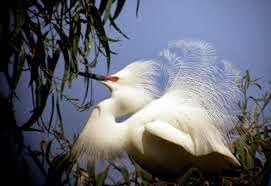
We'll also be visiting the bird sanctuary on Avery Island.  Under the Avery/McIlhenny family's management, Avery Island has remained a natural paradise, inhabited by many animal species, as well as by exotic plants from throughout the world.  In 1895, Edward Avery McIlhenny founded a bird colony, now called Bird City.  Why? Because at that time it was fashionable for elegant ladies to wear hats with beautiful feathers, bird feathers, egrets' feathers.  Plume hunters killed egrets by the thousands.  Edward gathered eight young egrets, raised them in captivity on the island and released them in the autumn to migrate across the Gulf of Mexico.  The following spring, the birds returned to the island with others of their species, a migration that continues today.
The snowy egret is so beautiful.   Take a look at this slideshow to see these birds and their beautiful feathers.
http://www.pamandedmundmcilhenny.com/keyword/bird%20city;avery%20island;snowy%20egret/i-xHRVQL6


This one is NOT a photo of Jane!

Jane, with no recipe today!
_________________________________________________
-species = espèces
-as well as = ainsi que
-from throughout the world = du monde entier
-gathered / raised / released / returned = Can you get the meaning of these verbs from the context?

Wednesday, April 15, 2015

38 (D-24) Avery Island /Tabasco sauce

The next day we'll visit Avery Island.  
Avery Island is actually a huge dome of rock salt, three miles (5km) long and two and a half miles (4km) wide. 
The island was named after the Avery family, who settled there in the 1830s.  But, long before the Avery family, it was the Native Americans who had discovered the massive salt dome.  They boiled the water to extract salt which they traded to other tribes.

Before the Civil War, Edmund McIlhenny married into the Avery family and later, in 1868, he started his business.  His product has come to your kitchen no doubt!  You do use Tabasco sauce sometimes, don't you???  Look at the bottle.  "Avery Island, Louisiana USA". It's made on Avery Island!  We can buy a bottle when we are there.
But before then, I'll share the recipe that is on my bottle, here in my kitchen.  I bought it at Super U!  

La vinaigrette qui réveille les salades
1 petite échalote hachée
1 cuillère à soupe de vinaigre balsamique de Modène
2 cuillères à soupe d'huile de noisette
quelques gouttes de Tabasco
sel
Mélanger tous les ingrédients en terminant par l'huile. Verser sur une salade et servir!


Jane


Tuesday, April 14, 2015

37 (D-25) Bayous and alligators

Not only New Orleans is water. There are miles and miles of bayous in southern Louisiana.  We are going to take a boat ride in a bayou near Houma.


Bayou. The word was first used by the English in Louisiana (1763)  and thought to originate from the Choctaw (Native American) word "bayuk" which means "small stream".   Larousse definition: "En Louisiane et dans la région du bas Mississippi, bras secondaire du fleuve ou lac établi dans un méaudre abandonné."  There is Bayou Teche, Bayou Lafourche, Bayou St John and others. But the bayous are disappearing.  Despite efforts to stop erosion of the bayous, Louisiana loses about an acre of land every 33 minutes.  That means it loses 25 square miles a year.
Many bayous are home to crawfish, shrimp, shellfish, catfish, frogs, herons, turtles and...American alligators.
Stop reading.  Let me take you there: https://www.youtube.com/watch?v=vKH9JEdZREc


Frequently asked alligator questions 
1.  How many alligators are in Louisiana?
Louisiana's wild alligator population is estimated to be nearly 2 million animals.  There are also more than 300,000 alligators on alligator farms in Louisiana.

2. When is Louisiana's alligator season?  There are two zones with one opening the last Wednesday in August, the other the first Wednesday in September, with a season lasting 30 days.  (We can't go alligator hunting this time!)

3.  Alligators are harvested for their hides and their meat.


Another recipe!  

Alligator Etouffee

Ingredients:

1 lb (454g) Alligator meat - cut in thin strips
1/2 lb Butter (100g)
1/2 cup Green onions - chopped
1/4 cup Parsley - chopped
2 Garlic cloves - minced
4 Celery stalks - chopped
1 can Tomatoes
salt, cayenne and black pepper

Directions:

Sauté onions, garlic and celery in butter until soft. Add tomatoes and simmer for 20 minutes in covered iron pot.

Add alligator meat and allow to cook over low heat until tender (approximately 1 hour). If too thick, add a little hot water.

Serve over rice.

Bon appétit!  But I'm not sure if you can find alligator meat at Picard's!

Jane 
___________________
stream = ruisseau
despite = malgré
an acre = 4047 m2
25 square miles = 65 km2
to harvest =  here, to gather, catch, hunt or kill (as salmon, oysters, deer or alligators) for human use, sport or population control
a hide = the skin of an animal, used especially for large, heavy skins
shellfish = http://www.wordreference.com/enfr/shellfish

Monday, April 13, 2015

36 (D-26) Houma / Cambrai... and an introduction to Cajun food

Welcome to Houma.
The area is famous for its food, fishing, swamps, music and hospitality.  Houma is also known for its Mardi Gras festivities.

Houma has a population of about 37,000.
It has an elevation of 10 feet (3m)!

Before the Civil War, the area was developed for plantations, where the work was done by enslaved African Americans.  Since the late 19th century, the Houma area has become more industrialized and has developed trade, but many residents in the surrounding communities continue to make their living as their ancestors did, as shrimpers, oystermen, crabbers, fishermen and trappers.  More people there are beginning to work in occupations of the oil industry and ship building.

Houma and the surrounding communities are filled with Cajun tradition and culture, a creolization of Native American, Acadian and African traditions.  (More on the Cajuns later.)

Did you see the film 2013 The Butler?  If so, you visited Houma because several scenes were filmed in downtown Houma.  Did you see the 2003 film Beasts of the Southern Wild?  The little girl in the film, Quvenzhané Wallis, is from Houma.
Have you ever been to Cambrai?  This city in northern France has been twinned with Houma since 1986!

FOOD:  A crawfish boil.  Like for a barbecue, many people get together to prepare and eat steamed crawfish with corn on the cob, often with Cajun music and Cajun dancing.  In France, it's moules-frites!

http://www.myinvisiblecrown.com/2013/02/24/perfect-crawfish-boil-recipe/
http://www.cajuncrawfish.com/how-to-boil-crawfish.htm


Jane, who is getting hungry preparing this post.
_______________________
-swamps = marais
-hospitality =  accueil
-if so = dans ce cas
-crawfish = écrevisses
-corn on the cob = épis de maïs

Sunday, April 12, 2015

35 (D-27) Houma, the city and the Native American people

Louisiana is the French, the Spanish, the British, the Africans, the Acadiens, the Haitians, the Germans and the Native Americans

Houma was founded by European Americans in 1834 at a former settlement of the Houma people who historically occupied this area. The town was named for them.

The Houma people are a historic Native American tribe.  Their descendants are called the United Houma Nation with about 17,000 tribal citizens today, living in six parishes: St Mary, Terrebonne, Lafourche, Jefferson, Plaquesmines and St Bernard parishes. http://geology.com/state-map/louisiana.shtml

The city of Houma, which means "red", is named after this people.

By the end of the 19th century, the Houmas had developed a creole language based on the French language of the former French colony.  The Houma-French language which the Houma people speak today is a mix between the French spoken by early explorers and Houma words.  However, Houma-French language is still a French language because it can be understood by French speakers from Canada, France or Louisiana.  There are some differences in vocabulary, for example, "chevrette" (shrimp).  The accent of the Houma Nation French-speaker is comparable to the difference between an English-speaker from the United States and an English-speaker from England.

Maybe we'll see if this wikipedia information is correct, should we have the opportunity to speak with someone from the Houma Nation when we are in Houma.


Jane, the English teacher...even during the holidays
_________________________________________________________
-should we have the opportunity = if we have the opportunity /  if there is a possibility of having the opportunity
http://www.grammaring.com/conditionals-and-inversion 
This is advanced English grammar..."If we have the opportunity" is perfectly fine.
"Should" is a nightmare for English-learners.  If you want to a little grammar revision during the holidays....or "Should you feel like doing some revision"...-->  https://www.englishclub.com/grammar/verbs-modal-should.htm

Saturday, April 11, 2015

34 (D-28) The German Coast / Lac des Allemands


Louisiana is the only state in the U.S. that has parishes (64) instead of counties as administrative areas.  Louisiana was formed from French and Spanish colonies, which were both officially Roman Catholic and local colonial government used the name "parishes" as the local ecclesiastical division (French: paroisse; Spanish parroquia*).

We are going to Houma which is in the parish of Terrebonne. Look first at the parishes north of Terrebonne: St. John the Baptist, St Charles and St James parishes.  This is where you find the German Coast.  Germans came early in the 18th century when John Law was advertizing Louisiana as a good place to live. Many died en route (in English we use the French expression) and only 300 arrived. This area to the east of the Mississippi River where they settled is called the Côte des Allemands. There is the Lac des Allemands and the town name in St Charles parish is known as Des Allemands. Later, in the middle of the 19th century, 53,000 German immigrants arrived at New Orleans---the nation's second-biggest port of entry after New York---in 1853.  Many German immigrants left Louisiana for other states, but about 25,000 Germans during these years made the Pelican State their adopted home.

The biggest slave revolt was in this part of Louisiana in 1811.  It was called the German Coast Uprising.  Nearly half of the total 95 slaves were killed during the fight; the others were executed after quick trials in parish courts.

During World War I, in a reaction against Germany as the enemy, all expressions of German culture and heritage, especially the printed or spoken use of the German language, were by law prohibited in the state. 

Very interesting and not too long:
Click here-->  http://ccet.louisiana.edu/tourism/cultural/The_People/german-american.html

For those of you who may be interested (particularly my students who are German or my retired German teachers) here is another (quite long) article....long, and it's in English, not in German!  You can read a part of it.
http://www.louisianafolklife.org/LT/Articles_Essays/German.html

Jane 
PS.  Today is our first day of Spring holidays!  You know that the blog will be here for you every day during your holidays!  Don't forget to take a look...every day!?
___________________________
*In English we have the noun "parish" and the adjective "parochial".  I went to a parochial elementary school in Louisiana. http://dictionary.cambridge.org/pronunciation/british/parochial
-trial = un procès
-Any other words you don't know?  Remember, you can go to your dictionary, or you can simply google the word followed by the word "traduction" and several dictionary sites will appear.  
I like www.wordreference.com and www.linguee.fr