Saturday, March 21, 2015

13 (D-49) Places, but people too: Marie Laveau

Marie Laveau
New Orleans isn't just places, it's people too.  Any idea of who Marie Laveau was?  She is buried in the St. Louis Cathedral Cemetery in New Orleans....fact or myth???


Voodoo Queen of New Orleans


Voodoo was brought to French Louisiana during the colonial period by workers and slaves from West Africa, and then again, by slaves and free people of color who were among the refugees from the Haitian revolution (1791-1804).  It was through Louisiana Voodoo that the words gris-gris and Voodoo doll were introduced into American vocabulary.

Jane 
_________________________________________                    

burial place --> sépulture
notorious --> http://www.wordreference.com/enfr/notorious
to flourish  -->   http://www.linguee.fr/anglais-francais/traduction/flourish.html
widely known  -->  http://www.thesaurus.com/browse/widely+known
gris-gris -->      http://www.thefreedictionary.com/gris-gris  
Voodoo doll -->  http://www.oxfordlearnersdictionaries.com/definition/english/voodoo-doll

In French this time... http://www.mindshadow.fr/histoire-vraie-marie-laveau/   But I don't think you should believe all this!  I don't believe it's "histoire vraie".  

Friday, March 20, 2015

12 (D-50) The French Quarter: Jackson Square, St Louis Cathedral

12 (D-50)  50 days before we leave.  
The French Quarter: landmarks.
First, Jackson Square and St Louis Cathedral.


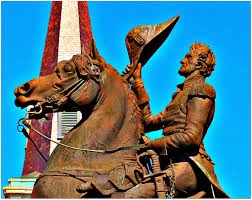
Jackson Square is a historic park in the French Quarter.  It was declared a National Historic Landmark in 1960.  Jackson Square was designed after the famous 17th-century Place des Vosges in Paris, by architect Louis Pilié.
Early French colonial New Orleans called this place the Place d'Armes.  The Spanish called it the Plaza de Armas.   The equestrian statue of Andrew Jackson was erected in 1856. The flagpole symbolizes the 1803 ceremonial transfers from Spain to France and then from France to the United States.  Andrew Jackson won decisive victories over the Indians and then over the main British invasion army at the Battle of New Orleans during the War of 1812.**  He later became the seventh President of the United States.

Originally you could see the Mississippi River from Jackson Square, but the view was blocked in the 19th century by the construction of higher levees.  For a long time, the riverfront was used as shipping docks.  The 20th-century administration of Mayor Moon Landrieu installed a scenic boardwalk on top of the levee to reconnect the city to the river;  it is know as the "Moon Walk" in his honor.  

St Louis Cathedral is the oldest continuously active Roman Catholic Church in the United States.  It was originally built in 1724 and rebuilt twice after a hurricane and a fire.  The present church was dedicated in 1794.

Jane
______________
** For history buffs:  The War of 1812 was a military conflict, lasting for two-and-a-half years, between the United States and the United Kingdom of Great Britain and Ireland, its North American colonies and its Native American allies.  In the Battle of New Orleans on January 8, 1815, Jackson's 5000 soldiers won a decisive victory over 7500 British. 
_______________
landmark =   A building or monument or place of historical importance     
flagpole =  le mât pour un drapeau
main = principal
levee =  return to Day 10 in this blog, if you have forgotten
boardwalkhttp://www.wordreference.com/enfr/boardwalk
buff = a devotee or well-informed student of some activity or subject: Civil War buffs.


Thursday, March 19, 2015

11 (D-51) The French Quarter

11 (D-51) 
New Orleans and The French Quarter (Le Vieux Carré)


You'll need to zoom in (double click) on the map to be able to see the names of the streets in downtown New Orleans.  Interesting names.  Can you find the streets Dauphine, Bourbon, Toulouse, Chartres, Esplanade Avenue, Elysian Fields (!) or Tchoupitouas?  You can even see the street where my grandparents lived on the far west side of New Orleans, on Coliseum Street
I lived to the north of the city in an area called Gentilly.  Can you find it on this google map?  Try zooming by clicking + at the bottom right hand corner. 

Jane
_____________________
Tchoupitouas --> The name of this street comes from the name of an extinct Indian tribe that perhaps means "those who live at the river" in Choctaw (hacha-pit-itula).


Wednesday, March 18, 2015

10 (D-52) NEW ORLEANS: A Few Facts First


Repeating yesterday's newsflash in case you didn't see it:
You can go to Louisiana!  In Challes les Eaux this Saturday March 21st.  Take a look here:  http://nonc.jack.pagesperso-orange.fr/cajun.htm
Click Bulletin de réservation to read more information about it.
I've been there several times.  It's so much fun!
_________________________________________
New Orleans: Two dictionary definitions:

A city of southeast Louisiana between the Mississippi River and Lake Pontchartrain.  Founded in 1718, it became the capital of a French colony in 1722 and passed to the United States as part of the Louisiana Purchase in 1803.  The city is known for its annual Mardi Gras celebrations and as the birthplace of jazz music.  In 2005, New Orleans was devastated by Hurricane Katrina, which caused breaches in the protective levee system that resulted in widespread flooding and the evacuation of much of the city.


A seaport in southeast Louisiana, on the Mississippi River, about 172 km (107 miles) from the sea; the largest city in the state and the second most important port in the US; founded by the French

in 1718; belonged to Spain (1763-1803).  It is largely below sea level, built around the Vieux Carré (French Quarter); famous for its annual Mardi Gras festival and for its part in the history of jazz; a major commercial, industrial and transportation center.

Population:  2014 population estimation for New Orleans is 379,000 people, which is down dramatically from 484,674 in 2000.  This is up from the 2010 Census population of 343,800, however, and New Orleans is growing and recovering from Hurricane Katrina that struck its coast in 2005.


Jane
___________________________________________________
breach  = a gap or a hole made in a wall or fortification
leveehttp://www.wordreference.com/definition/levee
widespread = extending over a wide area
flooding = the submerging of land under water http://www.wordreference.com/definition/flooding

Don't forget to use wordreference for pronunciation too.  Click the icon or click LISTEN.
OR 
DO YOU KNOW THIS SITE FOR PRONUNCIATION: http://www.howjsay.com  Enter the word in the box, click "SUBMIT" and then you have the pronunciation.  Try it.


Tuesday, March 17, 2015

9 (D-53) Three Flags Day

NEWS FLASH before today's blog entry:
You can go to Louisiana!  In Challes les Eaux this Saturday March 21st.  Take a look here:  http://nonc.jack.pagesperso-orange.fr/cajun.htm
Click Bulletin de réservation to read more information about it.
I've been there several times.  It's so much fun!
____________________________________________________
Three Flags Day commemorates March 9 and 10, 1804, when Spain officially gave the Louisiana (New Spain) colonial territory to France, who then officially turned over the same lands to the United States, in order to finalize the 1803 Louisiana Purchase.

The ceremony took place in St. Louis.


The Spanish flag was lowered on March 9, and the French flag was hoisted to fly over the city of St. Louis for 24 hours.  The French flag was initially to be lowered at sunset, but it remained present all night.  The next morning, March 10, 1804, the American flag was raised.  This event is sometimes referred to as the "Three Flag Ceremony" of the "Ceremony of Three Flags."  211 years ago, almost to the day.


Let's leave history for a while and go to New Orleans tomorrow.


Jane

__________________

--"to the day"  Do you know this expression?  You can guess from the context.  Let's go to Oxford dictionary this time: http://www.oxforddictionaries.com/definition/english/to-the-day
--to lower =the flag comes down
--to hoist = the flag goes up
--sunset = when the sun goes down


Monday, March 16, 2015

8 (D-54) So many different flags

8 (D-54)  54 days before we leave.
Dates and flags: 


French Fleur-de-Lys
1682  The French explorer Sieur de La Salle, the first to descend the Mississippi to its mouth, took possession "of the country known as Louisiana," and named it for the reigning monarch of France, Louis XIV. 


(The Spanish flag in New Spain at this time was The Burgundy Cross) 
1762  By the secret Treaty of Fontainebleau, France ceded its unprofitable and distant territories west of the Mississippi and the Isle of Orleans to Spain. It was 23 months later before the colonists in Louisiana learned they were no longer French subjects.


British Grand Union [1763]
1763  By the Peace of Paris, Great Britain acquired from France its Louisiana territory east of the Mississippi and north of the Isle of Orleans. Spain ceded to Britain its territories of East and West Florida. Baton Rouge was fortified by the British and called New Richmond.


Bourbon Spain [1769]  
1769   Spanish Governor Alejandro O'Reilly finally established firm control of Louisiana for Spain. 


French Tri-Color [1803] 
1800  Spain officially returned the Louisiana territory West of the Mississippi to France by the secret Treaty of San Ildefonso.   (France did not actually take control until November 1803.)


U.S. Flag of 15 Stars [1803]
"The Star Spangled Banner" 
1803   The United States purchased from Napoleon the territory of Louisiana for $15,000,000. 
1812   Louisiana formally became the 18th state to join the United States.

Jane

Sunday, March 15, 2015

7 (D-55) French Louisiana

DAY 7 (D-55)  55 days before we leave.
Of course, LOUISIANA got its name from the French.  René-Robert Cavelier de la Salle in 1682 during his expedition down the Mississippi gave to the land the name Louisiana, in honor of The Sun-King, Louis XIV.  On April 9, 1682, at the mouth of the Mississippi River La Salle buried an engraved plate and a cross, claiming the territory for France.

French Louisiana was an administrative district of New France.  Under French control 1682-1762 and 1802-1804, it originally covered a large territory, from the Great Lakes to the Gulf of Mexico and from the Appalachian Mountains to the Rocky Mountains.  Louisiana was divided into two regions, Upper Louisiana (Haute-Louisiane), which began north of the Arkansas River and Lower Louisiana (Basse-Louisiane), where we have the states of Louisiana, Arkansas, Mississippi and Alabama today.
The present-day US state of Louisiana is named for the historical region, but it occupies only a small part of the territory claimed by the French.


1

2


3


4

Napoleon sold Louisiana, as seen in maps 3 and 4, to the United States in 1803.

Jane